
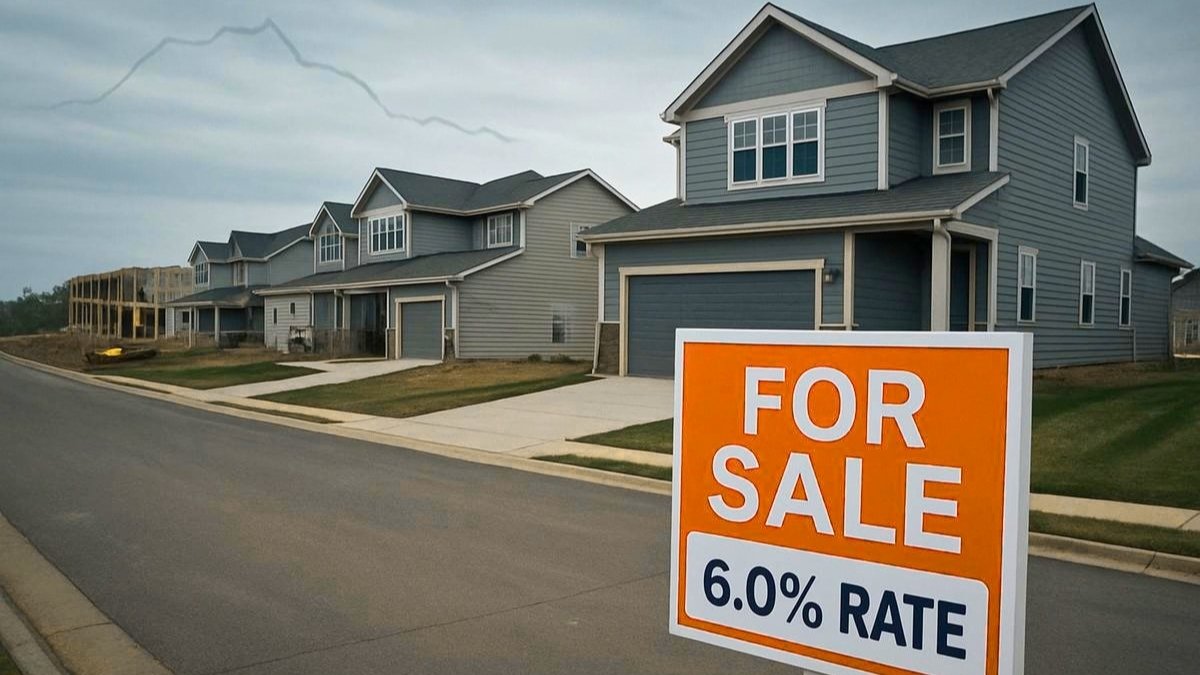
Mortgage rates have moved back above a key psychological level in the United States, adding fresh pressure to a housing market already grappling with affordability challenges.
The average 30-year fixed mortgage rate reached 7.03% on September 24, 2026, according to Freddie Mac. That was up from 6.95% the previous week and significantly higher than the 6.30% average recorded a year earlier. The average 15-year fixed mortgage rate also increased to 6.42%, compared with 5.49% a year earlier.
The increase raises an important question for prospective homebuyers: Why are mortgage rates rising again in 2026, and could they remain elevated?
The answer involves more than the Federal Reserve. Inflation, Treasury bond yields, economic growth, government borrowing and expectations about future interest rates all influence the cost of a mortgage.
Mortgage Rates Are Back Above 7%
The return of the 30-year mortgage rate above 7% is significant because many prospective buyers have been waiting for borrowing costs to fall.
Freddie Mac’s latest survey shows that the average 30-year fixed rate climbed from 6.95% to 7.03% in one week. At the same time, the rate remained well above its level from a year earlier.
It is important to understand that the Freddie Mac figure is a national weekly average, not necessarily the rate every borrower will receive. The survey focuses on conventional, conforming purchase loans for borrowers with strong credit and a 20% down payment.
Individual mortgage offers can therefore be higher or lower depending on credit history, down payment, loan type, property and lender.
Nevertheless, the benchmark provides a useful picture of the direction of U.S. mortgage borrowing costs.
Why Are Mortgage Rates Rising?
One of the biggest reasons is the movement of long-term U.S. Treasury yields.

Mortgage rates do not simply follow the Federal Reserve’s benchmark interest rate one-for-one. Thirty-year mortgage rates are heavily influenced by the bond market, particularly longer-term Treasury yields and expectations about inflation and economic conditions.
Recent Treasury-market pressure has been substantial. Reuters reported in September that the U.S. 30-year Treasury yield climbed to around 5.48%, its highest level since 2004, while the 10-year Treasury yield also rose sharply.
When investors demand higher yields on long-term government debt, borrowing costs across the economy can rise.
That can eventually feed through to mortgages.
1. Inflation Remains a Concern
Inflation is another important factor.
The Federal Reserve said in its September 16 statement that inflation remained elevated and that its policy action was intended to support a return toward its 2% inflation objective.
Persistent inflation can keep longer-term interest rates elevated because investors may demand greater returns to compensate for the possibility that purchasing power will erode.
Energy pricesand other inflationary pressures can therefore influence the broader interest-rate environment.
2. The Federal Reserve Still Matters
The Federal Reserve raised its federal funds target range by a quarter percentage point on September 16, bringing it to 3.75%–4%.
However, it would be misleading to say that the Fed directly sets the 30-year mortgage rate.
The Fed controls a short-term policy rate. Mortgage rates are determined by a much broader financial market.
Investors continuously assess what they believe the Fed will do in the future, how quickly inflation will fall, how strong economic growth will remain and how much government debt will need to be financed.
Those expectations influence Treasury yields, which can then affect mortgage rates.
3. Strong Economic Growth Can Keep Rates Elevated
The U.S. economy has also shown resilience.
In its September statement, the Federal Reserve said economic activity was expanding at a solid pace, while domestic spending remained resilient and productivity growth was strong.
A strong economy can create a complicated environment for interest rates.
If economic activity remains robust, investors may see less need for very low interest rates. At the same time, stronger demand can contribute to inflationary pressure.
That can make it harder for long-term borrowing costs to fall quickly.
What Does a 7% Mortgage Rate Mean for Homebuyers?

The most immediate effect is higher monthly payments.
Consider a hypothetical $400,000 30-year fixed mortgage with no taxes, insurance or other costs included.
At a 7% interest rate, the principal-and-interest payment would be approximately $2,661 per month.
At 6%, the same loan would cost approximately $2,398 per month.
That is a difference of roughly $263 every month, or more than $3,100 per year.
Over a long mortgage term, the difference can become substantial.
This is why even relatively small changes in mortgage rates can affect how much house a buyer can comfortably afford.
Higher Rates Can Change the Housing Market
Mortgage rates affect more than individual monthly payments.
When borrowing becomes more expensive, some buyers may delay purchasing a home.
Other buyers may lower their budgets and search for less expensive properties.
Existing homeowners can also become reluctant to sell if they currently have mortgages with much lower interest rates.
That can create an unusual housing-market dynamic.
A homeowner with a very low mortgage rate may hesitate to sell and replace that loan with a new mortgage at around 7%.
This can reduce the incentive to move, potentially limiting the supply of homes available for sale.
At the same time, buyers facing higher financing costs may become more price-sensitive.
The result can be a housing market in which both buyers and sellers remain cautious.
Does a 7% Mortgage Rate Mean Home Prices Will Fall?
Not necessarily.
Mortgage rates and home prices are connected, but one does not automatically determine the other.
Higher mortgage rates can reduce purchasing power, but housing prices are also influenced by:
- Local housing supply
- Population growth
- Employment
- Household income
- New construction
- Local economic conditions
- Demand from investors
- Migration between regions
- Available housing inventory
A market with limited housing supply can potentially maintain high prices even when mortgage rates are elevated.
That means buyers should not automatically assume that higher mortgage rates will produce an immediate housing-price collapse.
Could Mortgage Rates Fall Again?
They could, but the timing is uncertain.
Mortgage rates can decline if inflation falls, economic conditions weaken, Treasury yields decline or financial markets begin expecting lower future interest rates.
However, there is no reliable way to guarantee that mortgage rates will reach a particular level by a particular date.
The September data demonstrate why.
The average 30-year rate was 6.30% a year earlier but had risen to 7.03% by September 24, 2026.
That movement illustrates how quickly borrowing conditions can change.
For that reason, prospective buyers should be careful about making a home purchase decision based entirely on the expectation that mortgage rates will soon fall.
Should Homebuyers Wait for Lower Rates?
There is no single answer that applies to every buyer.
Someone who is financially ready to purchase, expects to remain in a property for many years and finds a suitable home may evaluate the purchase differently from someone who is stretching their budget to qualify.
Buyers should consider the total cost of ownership, not just the advertised mortgage rate.
That includes:
- Monthly principal and interest
- Property taxes
- Homeowners insurance
- Maintenance
- Closing costs
- Mortgage insurance where applicable
- Homeowners association fees
- Down payment requirements
A lower mortgage rate does not automatically make an unaffordable home affordable.
Likewise, a higher rate does not necessarily make every purchase financially unsuitable.
The important question is whether the complete payment fits comfortably within the buyer’s financial circumstances.
What About Refinancing?
Existing homeowners are also watching mortgage rates closely.
Refinancing generally becomes more attractive when a borrower can obtain a meaningfully lower rate than the rate on their existing mortgage, while also accounting for closing costs and how long they expect to keep the loan.
With the average 30-year fixed rate at 7.03% in Freddie Mac’s September 24 survey, homeowners who already have substantially lower mortgage rates may have little reason to refinance purely to obtain a lower rate.
However, refinancing decisions depend on the individual loan and financial situation.
Some homeowners may consider refinancing for reasons other than simply lowering the interest rate, such as changing the loan term or accessing equity.
The Bigger Story: Borrowing Costs Are Rising Across the Economy
The mortgage-rate increase is part of a broader financial-market story.
Long-term Treasury yields have been climbing, while investors continue to assess inflation, economic growth, government borrowing and future Federal Reserve policy.
Reuters reported that the September rise in long-term Treasury yields pushed the 30-year Treasury yield to its highest level since 2004.
That matters because government borrowing costs can influence the wider cost of credit.
Mortgages, corporate borrowing, consumer loans and other forms of long-term financing can all be affected by changes in financial-market yields.
What Should Homebuyers Watch in October 2026?
As October begins, several indicators will be particularly important for the housing market.
Inflation data
If inflation remains persistent, investors could continue demanding higher long-term yields.
Treasury yields
The 10-year and 30-year Treasury markets are important indicators of broader borrowing costs.
Federal Reserve policy
Investors will closely follow statements and economic projections from the Federal Reserve for clues about future monetary policy.
Employment and economic growth
A strong economy could support borrowing demand, while a significant slowdown could change expectations about future interest rates.
Weekly mortgage-rate data
Freddie Mac’s weekly Primary Mortgage Market Survey will provide an important benchmark for tracking whether the recent rise continues or reverses.
The Bottom Line
The return of the average U.S. 30-year mortgage rate above 7% is an important development for the housing market.
Freddie Mac reported an average rate of 7.03% on September 24, 2026, compared with 6.95% the previous week and 6.30% a year earlier.
The rise is being influenced by a combination of factors, including higher long-term Treasury yields, inflation concerns, economic conditions and expectations surrounding Federal Reserve policy.
For homebuyers, the immediate consequence is straightforward: borrowing money to purchase a home has become more expensive.
But mortgage rates can change, and the direction of the housing market depends on much more than one interest-rate reading.
As October begins, inflation, Treasury yields and Federal Reserve policy will remain among the most important factors to watch.
This article is for general informational purposes and does not constitute mortgage, investment or financial advice.