
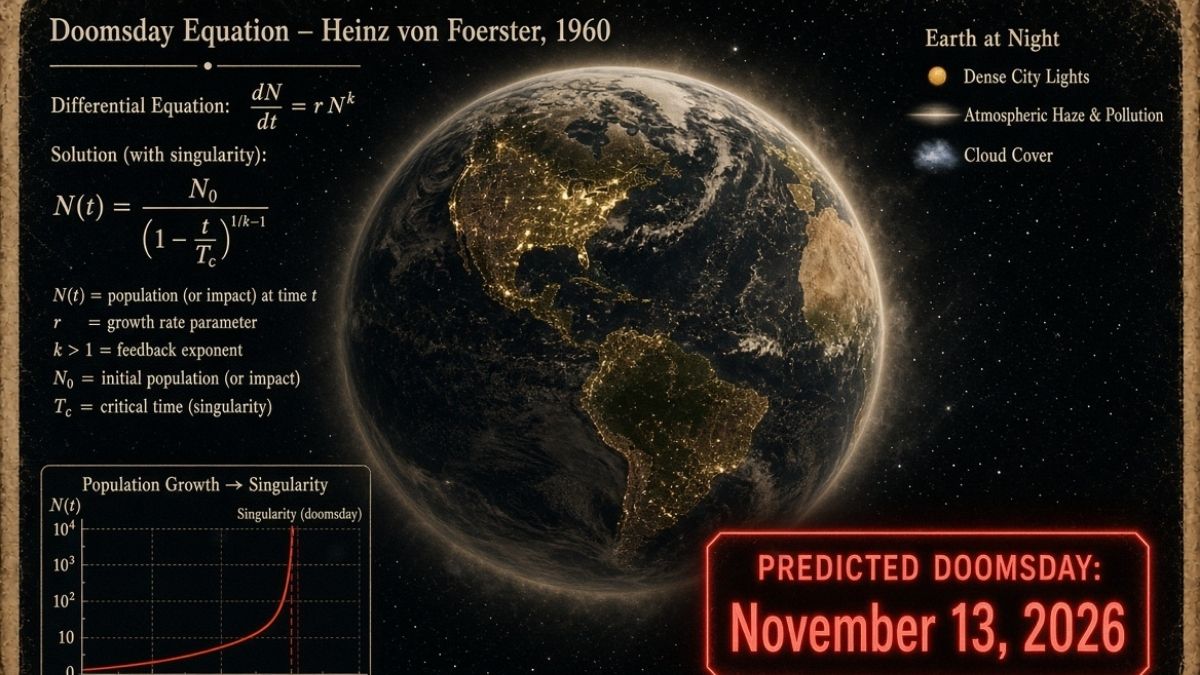
What if a scientific paper published more than 60 years ago had already identified the date when humanity could reach a mathematical breaking point? According to a controversial calculation made in 1960, that date is Friday, November 13, 2026.
The prediction sounds like something from a science-fiction movie. However, it came from a real research paper published in Science, one of the world’s most respected scientific journals. Physicist Heinz von Foerster and his colleagues developed a mathematical model suggesting that the world’s population was growing at an alarming rate.
Their warning was chilling: future generations would not necessarily starve because of a shortage of food but could become overwhelmed by the consequences of unchecked population growth.
With November 13, 2026, approaching, the old prediction has attracted renewed attention online. But what did the scientists actually calculate? Did they really believe the world would end on that Friday? And why did their mathematical prediction fail to match the population trends that followed?
To understand the story, we need to go back to 1960, when three researchers published a paper with an extraordinary title: Doomsday: Friday, 13 November, A.D. 2026.
Who Was Heinz von Foerster?

Heinz von Foerster was an Austrian-born physicist, cybernetician and researcher who became known for his work on complex systems, communication and the relationship between technology and society.
Born in Vienna in 1911, he later moved to the United States and worked at the University of Illinois. His research explored how systems behave, how information is processed and how different elements interact within complicated environments.
Von Foerster was particularly interested in the relationship between human society, technological development and population growth.
During the middle of the 20th century, rapid population growth had become an important concern among scientists, economists and policymakers. Improvements in medicine, sanitation and food production were helping people live longer, while birth rates remained high in many parts of the world.
Von Foerster and his colleagues wanted to understand what might happen if this growth continued accelerating.
Working with researchers Patricia M. Mora and Lawrence W. Amiot, he developed a mathematical model that produced one of the most unusual predictions in scientific history.
What Did the 1960 Scientific Paper Actually Predict?
On November 4, 1960, the journal Science published a research paper titled Doomsday: Friday, 13 November, A.D. 2026.
The paper examined historical estimates of the human population over approximately 2,000 years. The researchers noticed a pattern that attracted their attention: the human population appeared to be growing faster over time.
Instead of following a simple pattern in which population increased by a constant number of people every year, their calculations suggested that the rate of growth itself was increasing.
The researchers used this historical pattern to develop a mathematical projection. If the same growth pattern continued indefinitely, their equation suggested that the human population would approach infinity in 2026.
They described this theoretical point as Doomsday.
Their paper included a memorable warning:
“Our great-great-grandchildren will not starve. They will be squeezed to death.”
The statement was intended to draw attention to the potential consequences of unchecked population growth. It suggested that humanity could face enormous pressure if the number of people continued increasing without any change in the underlying trend.
However, the paper did not describe an asteroid hitting Earth, a nuclear explosion or a sudden global catastrophe. Its central argument was about population mathematics.

Why November 13, 2026?
One of the most interesting parts of the story is the specific date.
The researchers’ mathematical model produced a projected singularity in 2026. A mathematical singularity is a point at which a mathematical function approaches an infinite or undefined value.
In simple terms, the equation suggested that the projected population would grow without a finite limit as the calculated date approached.
The authors gave the date as November 13, 2026, which falls on a Friday.
But there is an important detail that many viral posts leave out. The exact day was not a scientific forecast of a physical disaster. November 13 was associated with von Foerster’s birthday, and the striking Friday-the-13th date helped give the paper its memorable title.
The underlying mathematical estimate was the important part, not the idea that something extraordinary would physically happen on a particular Friday.
The researchers also acknowledged uncertainty in their calculation. Their estimate was not a perfectly precise prediction of the future.
What Does ‘Squeezed to Death’ Actually Mean?
The phrase “squeezed to death” sounds frightening, but it needs to be understood in the context of the researchers’ argument.
They were discussing the pressure that could develop if the human population continued growing at an increasingly rapid rate.
More people would require more food, water, housing, energy, transportation and other essential resources. Cities would need to accommodate growing populations, while agricultural systems and natural environments would face increasing demands.
The researchers were concerned that humanity could eventually reach a point where the pressure created by population growth would become extremely difficult to manage.
Their argument was also connected to technological progress.
Technology can increase the amount of food and other resources available to people. However, the researchers considered whether these improvements could also support further population growth, creating a cycle in which more resources allowed more people to survive and reproduce.
Their concern was not simply that Earth had a fixed amount of food. It was about the relationship between population, cooperation, technology and the ability of society to support an ever-growing number of people.
Why Did the Doomsday Prediction Fail?

The most important reason the prediction did not come true is that human population growth did not continue following the same mathematical pattern.
The original model depended on the assumption that the accelerating growth observed in historical data would continue.
But human behaviour and demographic conditions changed significantly during the decades that followed.
Birth rates began declining across many countries. Families increasingly had fewer children, while access to education, healthcare and family planning improved.
Urbanization also changed family structures and lifestyles. In many countries, people began marrying later, having children later or choosing to have smaller families.
These changes affected population growth in ways that the original mathematical model could not fully account for.
According to a 2026 analysis published by The Conversation and republished by ScienceDaily, the world’s population began falling behind the model’s projections around 1993.
In other words, the mathematical pattern that had seemed convincing for decades no longer described what was actually happening.
This is an important lesson about scientific predictions. A mathematical model can explain historical data remarkably well, but that does not guarantee that the same pattern will continue forever.
Human societies are not fixed systems. People’s decisions, technologies, economic conditions and social behaviour can change the trends that models attempt to predict.
What Does Modern Population Research Say?
Modern demographic research presents a very different picture from the 1960 prediction.
According to the United Nations’ World Population Prospects 2024, the global population was approximately 8.2 billion in 2024.
The UN projects that the world’s population could reach around 10.3 billion in the mid-2080s, then gradually decline to approximately 10.2 billion by 2100.
This is a major difference from the idea of population growth accelerating towards infinity.
The United Nations also reports that global fertility has declined considerably. Women are having approximately one child fewer on average than they did around 1990.
In more than half of all countries and areas, fertility is now below the replacement level of approximately 2.1 births per woman.
Some countries, including Japan, China, Germany and Italy, are already experiencing population decline or significant demographic ageing.
However, population growthis not slowing everywhere at the same speed. Several countries, particularly in parts of Africa and Asia, are expected to experience substantial population increases over the coming decades.
This means that population-related challenges remain important. Governments still need to consider housing, employment, healthcare, education, food security and environmental sustainability.
But the modern evidence does not support the 1960 mathematical projection of an approaching population singularity.
Should We Be Worried About November 13, 2026?
No scientific evidence suggests that November 13, 2026, will bring an apocalypse or any sudden catastrophe.
The date comes from a mathematical projection published in 1960, not from evidence of an approaching asteroid, global disaster or other physical threat.
The original researchers were examining what might happen if population growth continued accelerating according to the pattern they had identified.
That assumption did not hold.
Modern population research shows that fertility rates have declined and that global population growth is expected to slow further. The United Nations anticipates a population peak later this century rather than unlimited growth.
Nevertheless, the original paper remains an interesting reminder of the challenges involved in predicting the future.
Population growth is still an important global issue, but the problems facing humanity today are more complicated than simply having too many people. Resource distribution, consumption patterns, economic inequality, climate change and technological development all influence how societies manage their populations.
November 13, 2026, should therefore be viewed as a historically interesting date rather than a reason to fear the end of the world.
What Can We Learn From the 1960 Doomsday Prediction?
More than six decades after its publication, the paper by Heinz von Foerster and his colleagues still offers an important lesson about mathematics, science and human behaviour.
The researchers identified a historical pattern and used it to calculate where that pattern might lead. Their model attracted attention because the result was extraordinary and the mathematical argument was based on real population data.
However, the future did not follow the same path as the past.
Falling birth rates, changing family structures, education, technology and social development altered the trajectory of human population growth.
The story demonstrates why predictions must be examined alongside their assumptions. Even a mathematical model that fits historical information can become unreliable when the conditions behind that information change.
It also reminds us that scientific warnings should encourage discussion and investigation rather than unnecessary fear.
On Friday, November 13, 2026, the world is not expected to end. But the date will mark an unusual moment in scientific history: the arrival of the day that three researchers once calculated as the mathematical endpoint of unchecked human population growth.
Their prediction did not become reality, but the question behind it remains relevant: how can humanity manage its resources and build a sustainable future for generations to come?