
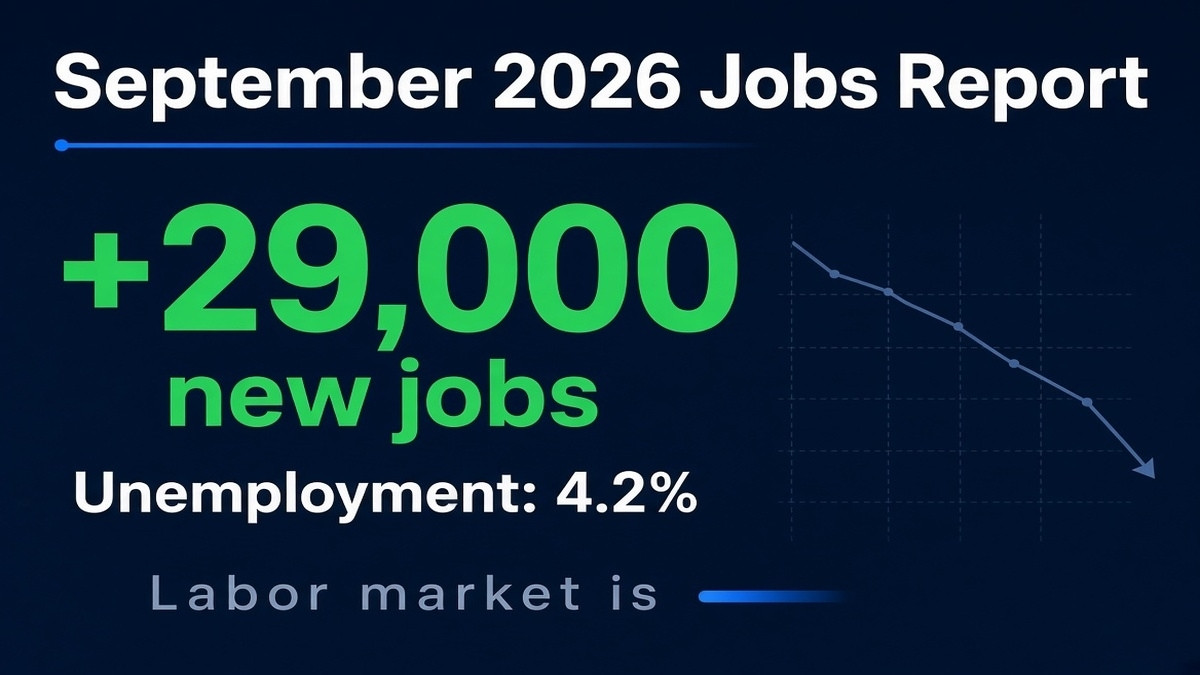
The U.S. job market was weaker than expected in September. Employers added only 29,000 new jobs. The unemployment rate edged up to 4.2%.
The report was released by the U.S. Bureau of Labor Statistics (BLS) on October 2. Most economists had expected around 90,000 new jobs. The numbers also included downward revisions to earlier months, which made the slowdown look a bit worse.
Does this mean a recession is coming?
Not necessarily. The job market has cooled a lot, but other signs still look fairly steady. It’s important to look at the details.
What the report showed
- New jobs: 29,000
- Unemployment rate: 4.2% (up from 4.1% in August)
- Number of unemployed people: about 7.1 million
- Average hourly pay rose 0.1% in September
- Pay is up 3.0% over the past year
- Average workweek: 34.4 hours
Hiring has slowed a lot compared with earlier this year. The unemployment rate has remained within a tight range of 4.1% and 4.3% since March.
Why so few jobs were added

Growth was uneven. Healthcare added about 17,000 jobs. Most other big industries—construction, manufacturing, professional services, leisure and hospitality, and government—showed little or no change.
A healthy job market usually needs growth in many different areas, not just one. This report shows employers are being more careful about hiring.
Earlier numbers were revised lower
July was revised from a gain of 21,000 jobs to a loss of 10,000. August was revised from +162,000 to +133,000. Together, these changes cut 60,000 jobs from the previous totals.
Monthly numbers often get revised later when more data comes in. That’s normal. Economists usually look at several months of data instead of just one report.
What about wages?
Average hourly earnings for private workers rose just 5 cents (0.1%) to $37.81. Over the past year, pay is up 3.0%.
Slower wage growth can make it harder for workers to keep up with costs. For the Federal Reserve, it can ease some worries about inflation.
Unemployment rose only a little
The rate moved from 4.1% to 4.2%. That’s a small change. The job market has cooled, but we haven’t seen a sharp jump in people out of work.
Companies often slow hiring before they start big layoffs. That’s why experts also watch job openings, layoff numbers, and unemployment claims.
What this means for the Federal Reserve
The Fed has to balance inflation and jobs. A weaker job market can support the idea of less-tight interest rates. The weak September numbers lowered expectations for another rate hike in October.
But the jobs report is only one piece of the puzzle. Inflation data and other economic numbers also matter a lot.
Why interest rates matter to regular people
Fed decisions affect the cost of mortgages, car loans, credit cards, and business borrowing. Higher rates make borrowing more expensive. Lower expected rates can eventually ease some of those costs—but the change is never instant, and different loans respond differently.
Bottom line for the economy
The U.S. labor market is cooling. Job gains were small, earlier months were revised down, unemployment edged higher, and wage growth slowed.
But the data do not show the economy is in a recession. The BLS itself said employment and the unemployment rate changed little in September.
The big question is whether September was a temporary soft month or the start of a longer slowdown. The next report, covering October, comes out on November 6, 2026.

What workers and job seekers should watch
- Unemployment rate – a steady rise would be more concerning
- Job openings – fewer openings make it harder to find work
- Wage growth – affects how much money people have to spend
- Hiring across industries – broad growth is a better sign than growth in just one sector
- Layoffs and unemployment claims – rising numbers would show companies are cutting staff
The bigger picture
The September report sends a mixed signal. The economy is still adding some jobs, unemployment is still relatively low, and healthcare continues to hire. At the same time, the 29,000-job gain was much weaker than expected, earlier months looked softer after revisions, and wage growth slowed.
The labor market has lost momentum. Whether this is temporary or the start of something bigger is the key question for the months ahead—and for the Federal Reserve.
Sources
- U.S. Bureau of Labor Statistics – September 2026 Employment Situation
- Reuters – U.S. September 2026 jobs report