
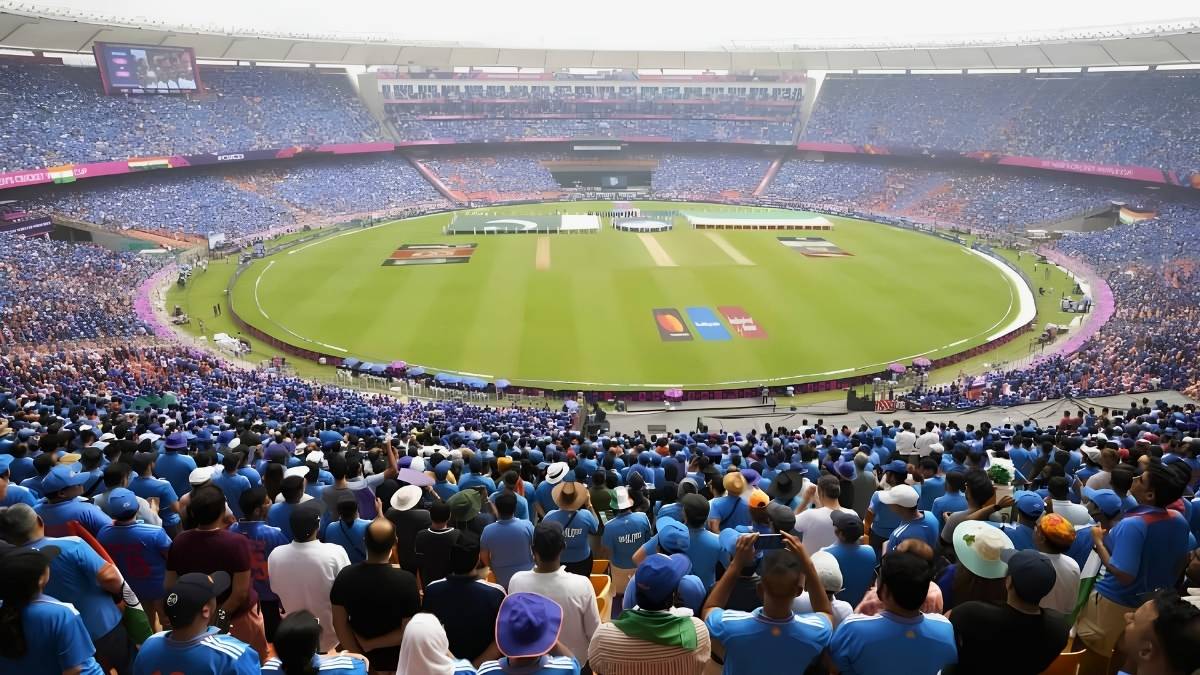
For decades, One Day International cricket occupied a special place between the patience of Test cricket and the explosive entertainment of T20.
But that middle ground is becoming increasingly difficult to defend.
The rise of franchise T20 leagues, increasingly crowded international calendars and changing viewing habits have raised a difficult question: Is ODI cricket dying?
The answer is not straightforward.
ODI cricket is certainly facing pressure. The format lacks the year-round commercial momentum of T20 cricket, and some bilateral ODI series struggle to generate the attention associated with major tournaments.
Yet the format remains central to international cricket’s biggest tournament.
The International Cricket Council (ICC) has just unveiled the schedule for the 2027 Men’s Cricket World Cup, which will feature 14 teams and 57 matches across South Africa, Zimbabwe and Namibia. The tournament begins in October 2027, with the final scheduled for November 21.
So perhaps the better question is not whether ODI cricket is dying.
It is whether the traditional way of playing and scheduling ODI cricket is becoming unsustainable.
Why are people asking if ODI cricket is dying?
The biggest challenge facing ODI cricket is not one particular problem.
It is competition.
Cricket now offers players and fans three major international formats, while franchise T20 competitions have become a powerful part of the sport’s calendar.
T20 cricket can deliver a complete match in roughly three hours. It is easier to fit into television schedules, more compatible with short-form digital content, and has developed a huge franchise ecosystem.
ODIs require considerably more time.
That does not automatically make the 50-over format outdated, but it does create a commercial challenge.
When fans have limited time, a three-hour T20 match can be an easier proposition than a game that may occupy most of a day.
T20 cricket has changed the economics of the sport

The strongest evidence for T20’s growing influence can be seen in its enormous audience.
During the 2026 Men’s T20 World Cup semi-final between India and England, JioHotstar reported a peak of 65.2 million concurrent viewers and 619 million total views. The ICC said the game also generated more than 320 million combined viewers across television and digital platforms.
The 2026 T20 World Cup final pushed the digital record even higher.
ICC CEO Sanjog Gupta later said the final reached 72.5 million digital concurrent users in India, highlighting the enormous scale that major T20 events can achieve.
These numbers do not prove that fans have abandoned ODI cricket.
They do, however, demonstrate the extraordinary commercial and digital appeal of short-format cricket.
T20 has become much more than a shorter version of the game.
It is now its own entertainment product.
Franchise cricket creates another challenge for ODIs
The growth of franchise cricket has changed the incentives surrounding professional cricket.
T20 leagues can offer players substantial financial rewards while requiring a relatively short commitment.
International cricket, meanwhile, requires players to travel between countries and manage increasingly complicated schedules involving Tests, ODIs and T20 internationals.
This creates a difficult balancing act.
Players have limited careers and bodies, while cricket boards have increasingly crowded calendars.
As the number of T20 competitions grows, ODI cricket has to compete for space.
That competition is particularly important for bilateral ODI series that do not have an obvious tournament consequence.
The problem with meaningless bilateral ODIs
This may be one of the biggest issues facing the 50-over format.
An ODI becomes more compelling when something important is at stake.
World Cup qualification, tournament progression, rankings or a major rivalry can give a match additional significance.
But when two teams play a bilateral ODI series with little obvious consequence beyond the series itself, casual viewers may have less reason to spend several hours watching.
This is precisely the issue that ICC leadership has been discussing.
ICC CEO Sanjog Gupta has argued that the era of “randomly” scheduled bilateral series needs to change, with international cricket requiring more context and meaningful competition. He has also argued that one-day cricket can continue to thrive rather than simply being preserved for tradition’s sake.
That is an important distinction.
The problem may not be ODI cricket itself.
The problem may be how ODI cricket is packaged and scheduled.
The 2027 World Cup shows ODI cricket still matters

There is an obvious contradiction in the idea that ODI cricket is simply disappearing.
The ICC has just announced one of the biggest events in the cricket calendar: the 2027 ODI World Cup.
The tournament will involve 14 teams across three host countries.
The schedule includes major matches such as India versus Australia and India versus Pakistan, while the knockout stages will be played in South Africa.
The ICC has also redesigned the tournament structure.
The 2027 World Cup will use three stages before the semi-finals, including a Super Series involving three teams, a group stage and a Super 7 phase. The ICC says the changes are intended to create more meaningful contests and strengthen competitive standards.
That tells us something important.
The governing body is not treating ODI cricket as an obsolete format.
Instead, it appears to be trying to make major ODI competitions more meaningful.
The World Cup may be ODI cricket’s biggest lifeline
There is a strong argument that ODI cricket’s future could increasingly revolve around major international tournaments.
Think about the difference between a World Cup match and an ordinary bilateral ODI.
A World Cup game can determine qualification for the next stage, affect a team’s tournament position and attract enormous international attention.
That creates a natural narrative.
A bilateral match without significant consequences does not always have the same urgency.
This could mean that ODI cricket eventually becomes more concentrated around meaningful competitions rather than being played simply because two teams happen to have an available window in the calendar.
In other words, ODI cricket may need fewer matches with greater significance.
What happens to countries like Nepal?
The future of ODI cricket matters particularly to Associate nations.
Countries such as Nepal depend on international cricket structures to develop players and compete against established cricketing nations.
Nepal’s ODI pathway is not simply about playing occasional high-profile matches.
It is part of a broader development system that gives Associate teams opportunities to compete internationally.
If bilateral ODI cricket declines sharply, there could be consequences for those teams.
A smaller number of meaningful competitions could potentially increase the value of each match, but fewer opportunities could also make it harder for developing cricket nations to gain experience.
That is why the future of ODI cricket should not be judged only through the lens of India, Australia or England.
For many emerging cricket nations, the 50-over format remains an important bridge between domestic cricket and the biggest international stage.
Why ODI cricket still offers something T20 cannot
Despite all the pressure, ODI cricket has one major advantage.
It offers a completely different strategic experience.
In a T20 match, teams have only 120 balls to score.
In an ODI, they have 300.
That creates room for a much wider range of tactics.
A team can survive a difficult opening period, rebuild through the middle overs and then launch an aggressive assault at the end.
Bowlers can be rotated differently.
Batters have more time to build innings.
Captains have greater scope to change plans.
That middle ground between Test cricket and T20 remains unique.
A five-day Test and a three-hour T20 are fundamentally different products.
ODI cricket provides something in between.
The challenge is convincing modern audiences that this longer format is worth their time.
Can ODI cricket be saved?
If the format is struggling, simply playing more ODIs may not be the answer.
The solution could instead involve making fewer matches more meaningful.
Several changes could help.
1. Reduce low-significance bilateral series
Instead of filling calendars with large numbers of bilateral ODIs, cricket authorities could prioritize competitions with clear consequences.
2. Give ODIs more context
A match becomes more important when players and fans understand what victory means.
Qualification points, league structures and tournament consequences can create that context.
3. Build better ODI competitions
The ICC could explore more structured ODI leagues or tournament systems that give teams meaningful objectives throughout a cycle.
4. Protect players from excessive workloads
A sustainable calendar matters.
Players cannot reasonably be expected to play every format at maximum intensity throughout the year.
5. Give Associate nations meaningful opportunities
If ODI cricket is redesigned, emerging nations should remain part of the system.
Otherwise, the format risks becoming concentrated among a small number of established cricketing countries.
Is ODI cricket actually dying?
The evidence suggests something more complicated.
ODI cricket is under pressure, but it is not dead.
T20 cricket has clearly become a dominant force in the modern game. Its shorter duration, franchise ecosystem and enormous digital audiences have changed the economics and entertainment value of cricket.
At the same time, ODI cricket remains the foundation of the Men’s Cricket World Cup.
The ICC is actively redesigning the World Cup format, and the 2027 tournament has already generated significant attention with major rivalries and matches scheduled across South Africa, Zimbabwe and Namibia.
The more accurate description may therefore be that ODI cricket is at a crossroads.
Its traditional role as the default limited-overs international format is being challenged by T20.
But its role in global tournaments remains extremely important.
The future may be quality over quantity
The future of ODI cricket could ultimately depend on whether administrators are willing to change the way the format is presented.
If fans continue to see too many bilateral matches with little at stake, interest could continue to decline.
But if ODI cricket becomes a competition where every match carries meaningful consequences, the format could retain a distinctive place in international cricket.
The 2027 World Cup will provide an important test.
The tournament will bring together 14 teams, major rivalries and a new competitive structure.
And there is another important signal from the ICC itself: its leadership is openly discussing how to give ODI cricket greater context rather than simply assuming that the format will survive unchanged.
So, is ODI cricket dying?
Not yet.
But the old version of ODI cricket may be running out of time.
The 50-over format now has to prove that it can offer something that T20 cannot — and that could determine whether it remains a central part of international cricket for the next generation.