

The James Webb Space Telescope has uncovered a surprising clue about one of the most extreme rocky planets known to astronomers: HD 3167 b, a scorching “lava world” located about 154 light-years from Earth.
The planet is so close to its parent star that it completes an entire orbit in less than one Earth day. Its dayside is hot enough for rock to potentially melt, making it an unlikely place for life as we know it.
Yet observations from the James Webb Space Telescope (JWST) suggest that this hostile world may have managed to retain an atmosphere.
That is what makes HD 3167 b particularly interesting. Rather than simply studying a world covered by exposed, molten rock, astronomers may now have an opportunity to investigate how an atmosphere can survive under conditions that should make atmospheric loss extremely difficult.
The finding was reported in a study published in The Astrophysical Journal Letters in July 2026.
What Is HD 3167 b?
HD 3167 b is a rocky super-Earth orbiting the star HD 3167in the constellation Pisces.
Despite its classification as a super-Earth, it is not necessarily Earth-like. NASA’s exoplanet catalog lists its radius at about 1.6 times Earth’s and its mass at roughly 4.8 times Earth’s mass. It takes approximately one day to complete an orbit around its star.
The planet was originally discovered in 2016 using the transit method, meaning astronomers detected the tiny dip in the star’s brightness as the planet passed in front of it.
The latest discovery is therefore not the planet itself. Instead, scientists have obtained new evidence about its atmosphere using JWST.
Why Is It Called a Lava Planet?
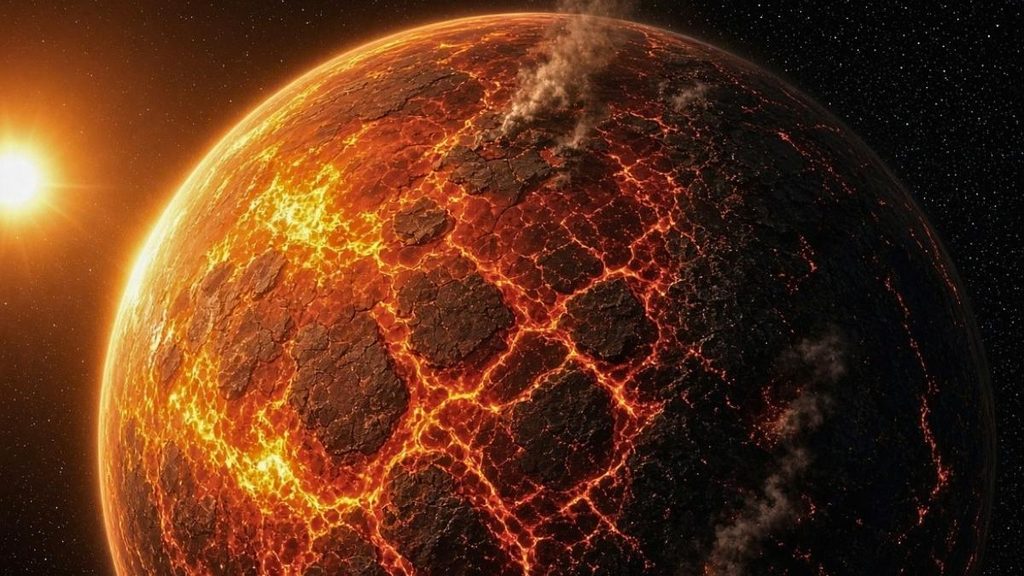
HD 3167 b belongs to a class of worlds known as lava worlds.
These are small rocky planets that orbit extremely close to their stars. Their intense stellar radiation can heat their surfaces to temperatures high enough to melt silicate rock.
The 2026 study estimates an equilibrium temperature of approximately 1,786 kelvin, although the planet’s actual surface and atmospheric conditions can be more complicated than this single number suggests.
The planet receives enormous amounts of radiation from its star because it orbits at only around 0.018 astronomical units.
For comparison, Earth orbits the Sun at about one astronomical unit.
That extraordinary proximity makes HD 3167 b an extreme laboratory for studying rocky planets.
A Planet That Should Struggle to Keep an Atmosphere

This is where the discovery becomes particularly interesting.
A planet orbiting so close to its star is exposed to intense radiation and stellar wind. Over long periods, those conditions can strip gases from a planet’s atmosphere.
Scientists therefore expected extremely hot rocky planets to have difficulty retaining substantial atmospheres.
But the JWST observations of HD 3167 b produced a different picture.
Astronomers measured the planet during a secondary eclipse, when the planet moves behind its star from Earth’s perspective. By measuring the change in infrared light from the system, researchers can estimate how much thermal radiation is coming from the planet’s dayside.
The measured eclipse signal was significantly lower than expected for a dark, maximally hot bare-rock surface.
The researchers measured an eclipse depth of about 38 parts per million, with an uncertainty of 11 parts per million. The result was more than five standard deviations below the expected signal from a maximally hot bare rock.
That unexpected result provides evidence that something is cooling the planet’s dayside.
One possibility is an atmosphere.
How Could an Atmosphere Cool Such a Hot Planet?
Scientists propose that an atmosphere could affect HD 3167 b in two important ways.
1. Reflecting incoming starlight
An atmosphere containing reflective material or clouds could bounce some of the star’s energy back into space.
That would reduce the amount of energy absorbed by the planet.
2. Moving heat around the planet
If the planet has an atmosphere capable of transporting heat, energy absorbed on the dayside could be redistributed toward the nightside.
This would make the dayside cooler than an exposed bare-rock surface would otherwise be.
The researchers say either atmospheric heat redistribution or reflection could contribute to the observed result. A highly reflective surface is another possible explanation, meaning the observations do not yet prove exactly what the atmosphere contains—or even conclusively establish its composition.
That distinction is important.
This Is Not an Earth-Like Atmosphere
The discovery should not be interpreted as evidence that HD 3167 b has an atmosphere similar to Earth’s.
Scientists have not yet determined its atmospheric composition from these observations.
The current JWST data are consistent with an atmosphere that could cool the dayside, but the available emission spectrum is not precise enough to identify the atmospheric gases.
Researchers say additional observations with JWST’s NIRSpec instrument could help investigate its composition.
So the headline-worthy discovery is not “scientists found an Earth-like atmosphere.”
It is more accurately described as evidence that an atmosphere may survive on an extraordinarily hot rocky planet.
Why Is HD 3167 b Important?
The planet could help scientists answer a much bigger question:
How do rocky planets form and retain atmospheres?
Atmospheres are crucial in determining a planet’s surface environment. On Earth, the atmosphere regulates temperature, transports heat, and contains the gases necessary for life.
But scientists still have many unanswered questions about how rocky planets acquire their atmospheres and how those atmospheres evolve.
HD 3167 b offers an extreme natural laboratory.
Because the planet is exposed to such intense radiation, any atmosphere that survives there could provide valuable information about atmospheric loss and planetary evolution.
Researchers describe HD 3167 b as the least irradiated ultra-short-period super-Earth with evidence for an atmosphere.
Could This Planet Resemble Early Earth?
Surprisingly, studying a planet covered in molten rock could also tell scientists something about our own planet’s distant past.
Researchers studying lava worlds have suggested that some young rocky planets—including early Earth—may have experienced extremely hot conditions during their formation.
The University of Chicago team behind the study notes that studying these worlds could provide a window into Earth’s earliest history and the development of atmospheres on rocky planets.
Of course, HD 3167 b is not an ancient version of Earth.
It is a very different planet orbiting a different star under vastly different conditions.
But by examining its atmosphere and surface environment, scientists can test models describing how rocky planets behave when they are subjected to extreme heat.
The Planet Has an Extremely Short Year

One of the strangest features of HD 3167 b is its orbital period.
A year on the planet lasts approximately 0.96 Earth days.
In other words, the planet completes a trip around its star in less than 24 hours.
That places it in the category of ultra-short-period planets.
Because it is so close to its star, the planet is also expected to experience enormous tidal effects. Scientists consider such planets particularly useful for studying the interaction between intense stellar radiation, planetary surfaces and atmospheres.
Is HD 3167 b Habitable?
No.
HD 3167 b is far too hot to be considered a habitable world like Earth.
Its extreme irradiation and likely molten surface make it an extraordinarily hostile environment.
The importance of the discovery is not that scientists have found another potential home for life.
Instead, it is about understanding how rocky planets work.
Finding evidence for an atmosphere on such a hot world challenges some expectations about how easily atmospheres can be stripped away.
And that could ultimately improve scientists’ understanding of which rocky planets are capable of retaining atmospheres under less extreme conditions.
What Will Scientists Study Next?
The next major goal is determining what the possible atmosphere is actually made of.
JWST’s NIRSpec instrument could provide additional spectroscopic observations that may reveal atmospheric signatures.
Researchers also want to understand better whether the planet’s relatively cool dayside is caused mainly by atmospheric heat redistribution, reflective clouds, a highly reflective surface, or some combination of these effects.
Future observations could therefore turn an intriguing atmospheric clue into a much more detailed picture of this bizarre planet.
A New Window Into Rocky Worlds
HD 3167 b demonstrates why exoplanet science has become so fascinating.
Scientistsare no longer simply discovering planets outside the Solar System. Powerful observatories such as JWST are beginning to investigate their temperatures, atmospheres and physical environments.
A planet that completes an orbit in less than a day and may have molten rock on its surface sounds like the last place where an atmosphere should survive.
Yet that is precisely what makes HD 3167 b so valuable.
The evidence does not show that the planet is habitable, nor has it revealed an Earth-like atmosphere. But it does suggest that even some of the most extreme rocky worlds may be capable of holding onto an atmosphere.
For scientists trying to understand how planets evolve—and how worlds like Earth became habitable—that is a discovery worth watching.
The next observations of HD 3167 b could reveal whether its atmosphere is genuinely present, what it contains, and why it has survived so close to its star.