
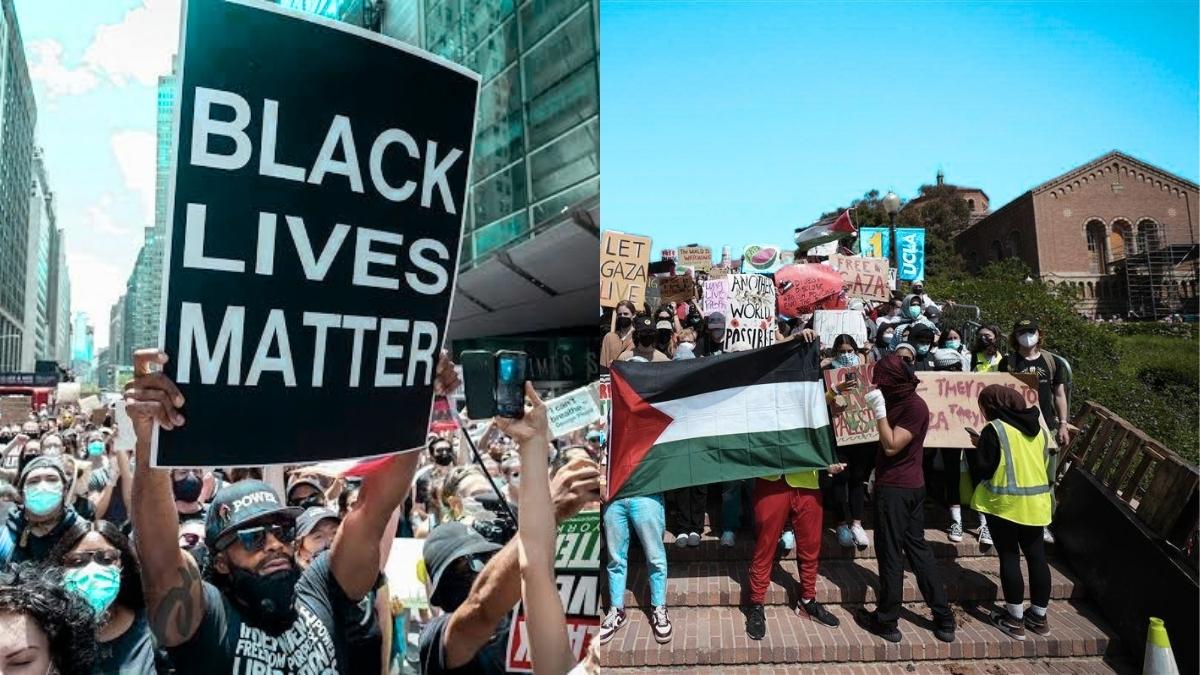
Political movements depend on persuasion. They organize demonstrations, create slogans, pressure institutions and ask ordinary people to support their causes.
But there is a difficult question that modern activism increasingly raises:
When does persuasion become pressure to conform?
That question can be asked about movements associated with both “Free Palestine” and Black Lives Matter.
The two movements are not the same. They emerged from very different histories and focus on different political issues. Black Lives Matter grew out of opposition to racism, police violence and racial inequality, particularly in the United States. “Free Palestine” encompasses a range of positions concerning Palestinian rights, Israeli policy, occupation, statehood, the war in Gaza and the Israeli-Palestinian conflict.
Nevertheless, both have at times generated intense political and social pressure around what individuals and institutions should say, display or support.
That does not mean every supporter of either movement attempts to silence disagreement. It means something more limited—and more important—is worth examining:
Can a movement advocate passionately for justice while still accepting that other people may disagree?
Persuasion is not the same as conformity
There is nothing unusual about activists trying to persuade people.
A climate activist wants governments to change environmental policies. A labor movement wants workers to organize. A civil-rights campaign wants discriminatory practices to end. A pro-Palestinian activist wants governments and institutions to change policies concerning Israel and Palestinians.
Political activism would be meaningless without attempts to influence other people.
The problem begins when disagreement itself becomes evidence of moral failure.
There is a major difference between saying:
“I believe you are wrong, and here is why.”
and saying:
“If you disagree with me, there is something wrong with you.”
The first is political debate.
The second can become social pressure.
And social pressure does not always look like formal censorship. A person can technically remain free to express an opinion while believing that doing so could cost them friendships, employment opportunities, academic standing or professional relationships.
That is where the discussion becomes complicated.
What happened around Black Lives Matter?
The enormous protests following George Floyd’s killing in 2020 provide one example of how political activism can move into workplaces and institutions.
At Coinbase, employees pressured the company to publicly acknowledge Black Lives Matter and the racial-justice movement. Employees organized a virtual walkout after discussions with management failed to resolve the issue. CEO Brian Armstrong eventually expressed support for Black Lives Matter and announced measures relating to diversity and inclusion.
Several months later, Armstrong announced that Coinbase would become more explicitly “apolitical” and offered severance to employees who did not want to remain under the company’s new direction.
There are at least two ways to interpret this episode.
Employees could reasonably argue that they were asking their employer to recognize an important social issue.
Armstrong could reasonably argue that employees should not be required to participate in political activism as part of their employment.
Both perspectives illustrate the same underlying problem:
How much political conformity should an institution expect from the people inside it?
The question is bigger than Black Lives Matter.
It applies to almost every political cause.
The UCLA case and the danger of turning disagreement into punishment
A more controversial example emerged at UCLA in 2020.
After George Floyd’s killing, a student asked lecturer Gordon Klein to modify the requirements for a final examination for Black students. Klein declined, and a petition calling for his dismissal subsequently attracted more than 20,000 signatures.
UCLA placed Klein on mandatory leave. The university later concluded its investigation, and Klein was subsequently reinstated.
People can disagree about Klein’s email, the student’s request and UCLA’s response.
But the episode illustrates an important principle:
A disagreement about racial policy can quickly become a demand for professional consequences.
That does not mean the people who signed the petition were trying to abolish free speech. They may have believed they were demanding accountability.
But accountability and conformity are not always easy to distinguish.
If a professor, employee or student begins believing that expressing the wrong political opinion could cost them their position, the environment can become hostile to genuine disagreement even without an official censorship policy.
The Palestine debate has produced a similar conflict
Since the October 7, 2023 Hamas attack and the subsequent war in Gaza, American universities have become major centers of political conflict over Palestine.

Students established encampments, organized demonstrations and demanded that universities divest from companies or institutions they believed were connected to Israel.
Some demonstrations remained peaceful. Others resulted in arrests, disciplinary proceedings and clashes over university rules.
A recent example demonstrates how complicated the issue has become.
In September 2026, the American Civil Liberties Union and Amnesty International USA published a report examining responses to pro-Palestinian activism at 80 universities and colleges across 28 states and Washington, D.C. The organizations argued that universities, police and government authorities had in some cases suppressed protected political expression.
That evidence is important—but it also complicates the argument that the “Free Palestine” movement itself is forcing people to conform.
In many of these documented cases, the pressure was actually coming against pro-Palestinian activists, through disciplinary actions, arrests, institutional restrictions or government intervention.
So a serious discussion cannot simply portray one side as the aggressor and the other as the victim.
The political environment surrounding the movement has involved pressure from multiple directions.
Protesters also have responsibilities
Defending the right to protest does not mean every protest tactic should be considered acceptable.
Universities have legitimate responsibilities to protect students and maintain their ability to operate.
The ACLU itself has argued that universities can enforce reasonable, content-neutral rules governing the time, place and manner of protests. It has also emphasized that physically intimidating people, blocking their movement or engaging in violence is conduct rather than protected political expression.
That distinction is crucial.
A person has the right to protest for Palestinian rights.
Another person has the right to disagree with that protest.
A university has the responsibility to protect both groups while applying its rules fairly.
The same principle applies to demonstrations supporting racial justice.
When slogans become tests of political loyalty
One of the more troubling developments in modern political culture is the transformation of slogans into tests of character.
A slogan can begin as a statement of solidarity and eventually become something people feel expected to repeat.
This can happen with:
“Black Lives Matter.”
It can happen with:
“Free Palestine.”
It can also happen with countless slogans from conservative, progressive, religious, nationalist and environmental movements.
The problem isn’t the slogan itself.
The problem is the assumption that refusing to repeat it automatically reveals someone’s moral character.
A person might support racial equality but disagree with a particular organization associated with Black Lives Matter.
A person might support Palestinian civilians while disagreeing with particular political interpretations of “Free Palestine.”
A person might support Israel’s existence while strongly criticizing the Israeli government’s policies.
Political identities are rarely as simple as social media suggests.
Criticism is not automatically hatred
This is particularly important in the Israel-Palestine debate.
Criticism of the Israeli government is not automatically antisemitism.
Likewise, criticism of Hamas or other Palestinian political actors is not automatically anti-Palestinian or anti-Muslim.
The ACLU has made a similar distinction in its guidance on campus speech, arguing that political criticism of Israel and support for Palestinian rights can be protected expression, while targeted harassment or intimidation of individuals because of ethnicity or national origin is different.
That distinction should be applied consistently.
The same principle should exist in debates about racial justice.
Criticizing a particular protest tactic does not automatically make someone racist.
Questioning a policy associated with Black Lives Matter does not automatically mean someone opposes racial equality.
The content of the criticism matters.
The conduct matters.
The context matters.
The comparison has limits
It would be intellectually lazy to say that Free Palestine and Black Lives Matter are simply the same movement.
They aren’t.
Black Lives Matter developed around racial justice and the treatment of Black people, particularly in the United States.
The Free Palestine movement concerns a national, territorial and geopolitical conflict involving Palestinians and Israelis, with enormous historical, religious and international dimensions.
Their slogans, organizations, political goals and histories are different.
Even within each movement there is disagreement.
Some people advocating Palestinian rights support a two-state solution. Others support a single state. Some focus primarily on humanitarian protection. Others emphasize ending Israeli occupation or changing Western foreign policy.
Similarly, people who support racial justice disagree over policing, criminal justice reform, affirmative action, economic inequality and the tactics of particular activist organizations.
Neither movement has a single voice.
The real question is freedom to disagree
Perhaps the most useful comparison is therefore not:
“Are Free Palestine and Black Lives Matter the same?”
It is:
“Can supporters of these causes tolerate disagreement?”
The answer should be yes.
Someone should be able to support Palestinian rights without supporting every slogan or tactic used by pro-Palestinian activists.
Someone should be able to oppose racism without endorsing every organization or policy associated with Black Lives Matter.
And someone should be able to criticize either movement without automatically being assigned the worst possible motive.
That principle has to work in both directions.
Pro-Palestinian activists should be free to criticize Israeli government policy.
Pro-Israel advocates should be free to criticize Palestinianpolitical organizations.
Racial-justice activists should be free to criticize police practices.
Critics of particular racial-justice policies should be free to explain their objections.
Nobody should be required to surrender their political judgment simply because a particular slogan has become popular.
The danger of political conformity
Political conformity is dangerous because it can eventually move beyond one issue.
Today, someone may be pressured to express solidarity with one cause.
Tomorrow, someone else may be pressured to endorse a completely different cause.
If society accepts the idea that refusing to adopt a popular political position deserves professional punishment, social exclusion or institutional retaliation, the principle can eventually be used against almost anyone.
This is why freedom of expression cannot depend on whether a particular opinion is fashionable.
Free speech is easiest to defend when we agree with the speaker.
Its real test comes when we strongly disagree.
Activism should persuade, not demand uniformity

Political movements have every right to campaign, protest, organize and persuade.
They can ask companies to change policies.
They can demand that universities divest.
They can organize demonstrations.
They can ask governments to change foreign policy.
They can call on ordinary people to support their cause.
But there should remain a boundary between asking people to agree and treating disagreement as unacceptable.
That boundary protects activists as much as it protects their critics.
A movement that defends freedom of expression should be willing to tolerate criticism.
A movement that claims to represent justice should not require universal agreement before it accepts someone’s good faith.
And institutions should not punish people simply because their political views are unpopular—while still being entitled to address genuine harassment, threats, violence and unlawful conduct.
Conclusion: Justice does not require everyone to think alike
The comparison between “Free Palestine” and Black Lives Matter is useful only if it is made carefully.
They are not the same movement.
Their histories are different.
Their objectives are different.
Their political contexts are different.
But both demonstrate how modern political activism can extend beyond traditional protest and into workplaces, universities, social media and everyday relationships.
That creates a difficult challenge for a democratic society.
How do we fight for causes we believe are just without demanding that everyone else believe exactly what we believe?
The answer cannot be to eliminate protest.
It cannot be to silence activists.
And it cannot be to punish people merely for holding unpopular opinions.
The better principle is simpler:
Persuade people. Debate them. Challenge them. Protest against their policies. But leave them free to say no.
A cause does not become stronger because everyone is afraid to question it.
It becomes stronger when its arguments can survive disagreement.
And perhaps that is the standard every political movement—whether “Free Palestine,” Black Lives Matter, or something entirely different—should be willing to accept.