

Pickleball has exploded in popularity as a dynamic paddle sport that merges aspects of tennis, badminton, and table tennis into an engaging activity suitable for people of all ages and fitness levels. This detailed beginner’s guide explores the fundamentals, including court layout, necessary gear, gameplay rules, scoring mechanics, and practical advice to help you get started. Whether you’re just discovering this sport or seeking to improve your understanding, you’ll find everything needed to enjoy it fully. With its straightforward setup and emphasis on strategy, pickleball offers endless fun and social opportunities.
How is Pickleball Played: Understanding the Basics
To fully appreciate pickleball, it’s helpful to know its origins and core principles. Invented in 1965 on Bainbridge Island, Washington, by Joel Pritchard, Bill Bell, and Barney McCallum, the sport began as a simple backyard game using makeshift equipment. It has since evolved into a professional-level activity with tournaments worldwide. The essence of pickleball lies in its accessibility: the smaller court size and lighter equipment reduce physical demands compared to similar sports, allowing players to focus on technique and teamwork. In doubles, which is the most common format, partners coordinate to cover the court effectively, while singles demands quick individual decision-making.
How is Pickleball Played: The Court and Equipment Essentials
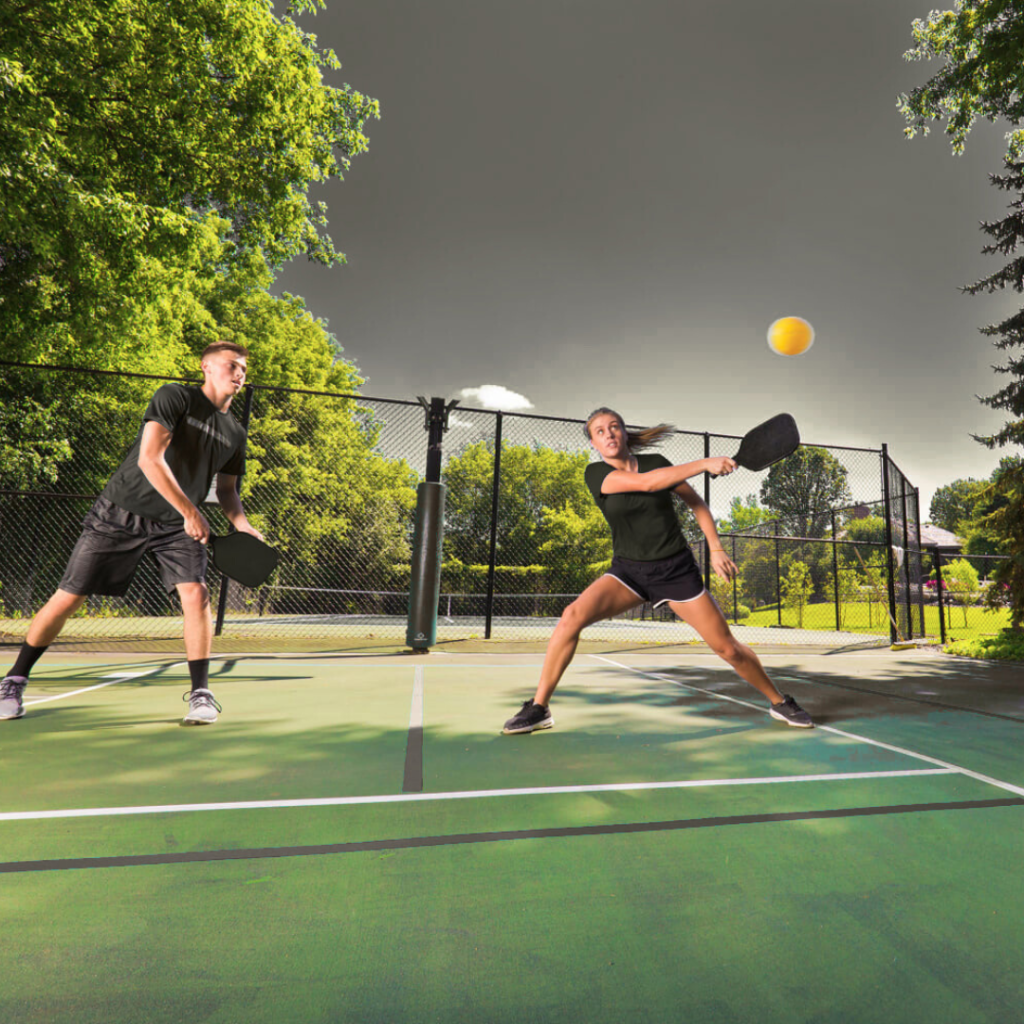
The playing area and tools are foundational to the sport. The court measures 20 feet wide by 44 feet long for both singles and doubles, featuring a net that’s 36 inches high at the edges and 34 inches at the center. This setup resembles a badminton court but is adapted for paddle play. A distinctive feature is the non-volley zone, commonly known as the “kitchen,” a 7-foot strip on either side of the net where certain shots are restricted to encourage fair and prolonged exchanges.
Equipment remains minimal and affordable:
- Paddle: These are solid, rectangular tools typically 15-17 inches long, constructed from wood, composite materials, or graphite. Beginners often prefer composite options for their blend of durability and responsiveness.
- Ball: A plastic sphere with 26-40 circular perforations, akin to a wiffle ball. Versions for outdoor use are sturdier to withstand wind, whereas indoor balls prioritize smooth bouncing.
- Attire and Extras: Comfortable sportswear and shoes with excellent traction are advised. Accessories like paddle grips or protective eyewear can enhance comfort and safety during sessions.
This simplicity in setup allows for easy conversion of existing spaces, such as tennis courts, into pickleball areas using temporary lines and nets.
How is Pickleball Played: Step-by-Step Rules Breakdown
The regulations, standardized by bodies like USA Pickleball, provide structure while allowing room for tactical creativity. Let’s break them down systematically.
Starting the Game
Play commences with a random selection, such as a coin flip, to determine the initial serving side. The server positions themselves behind the baseline on the right and delivers the ball underhand across the net to the opposite service area. Importantly, points can only be earned by the team currently serving, so the opposing side aims to create errors to regain control.
Serving Mechanics
The serve involves an underhand motion where the paddle strikes the ball below waist height in an upward swing, with the palm facing upward. The ball must travel over the net and land in the designated diagonal zone on the other side, avoiding the restricted area near the net. Should the ball graze the net but still reach the correct spot, the play proceeds without interruption.
In team play, each pair alternates serves, with an exception at the outset where the score begins at 0-0-2 to ensure equity. Servers change positions after successful points. For individual matches, the server shifts sides according to their current tally: even numbers from the right, odd from the left.
The Double-Bounce Rule
A core regulation requires the served ball and its immediate return to each bounce once before airborne strikes are permitted. This prevents overly aggressive openings and fosters balanced, engaging sequences of play.
Volleys, the Kitchen, and Dinking
Airborne hits, or volleys, are allowed outside the restricted zone but forbidden within it or on its boundaries. Players must avoid entering this area due to follow-through momentum after such a shot, or it results in a penalty. This setup highlights “dinking,” where participants exchange gentle, low shots over the net into the opponent’s restricted space, building tension and setting up decisive moments.
Faults and Line Calls
Penalties arise from actions like sending the ball outside the boundaries, into the net, improper serving, airborne hits in forbidden areas, or ignoring the bounce requirement. Contacting a player or their attire with the ball before it bounces also counts as an error. Such mistakes halt action, potentially awarding a point or transferring service. Boundaries are inclusive if the ball touches the line, except for serves in the restricted zone.
How is Pickleball Played: Mastering the Scoring System
The point system adds a layer of intrigue, with matches usually reaching 11 points and requiring a two-point advantage to win. Some competitive settings extend this to 15 or 21. Points are exclusively tallied by the serving side upon winning an exchange; errors by them lead to a service switch without the opponent gaining.
Scores in team games are vocalized as three figures: serving side’s total, receiving side’s total, and the active server’s identifier (1 or 2). For example, “6-4-1” indicates the servers lead 6 -4, with their first member up. Individual games use two figures: the server’s total followed by the receiver’s.
In pairs, both members serve sequentially before turnover, barring the initial exception. Solo play sees immediate switches on mistakes, with positioning linked to the score. Vocalizing the tally before each serve prevents mix-ups, and corrections can briefly pause proceedings.
How is Pickleball Played: Tips and Strategies for Beginners
Enhance your experience with these practical suggestions:
- Develop Footwork: Maintain an athletic stance to react swiftly, crucial for covering ground in team scenarios.
- Hone Dinking Skills: Dedicate practice to controlled, short exchanges to dominate the net area.
- Prioritize Team Communication: Use verbal cues to coordinate with partners and prevent overlaps.
- Steer Clear of Pitfalls: Those familiar with racket sports should consciously respect the restricted zone. Consistent serving practice minimizes early errors.
- Incorporate Variety: Mix in high lobs and soft baseline drops to keep opponents guessing.
- Engage Socially: Participating in group sessions or leagues accelerates learning and builds connections.
The activity also promotes physical well-being, enhancing heart health, flexibility, and coordination in a joint-friendly manner.
How is Pickleball Played: Why It’s More Than Just a Game
This sport transcends mere recreation, serving as a community builder. Mixed formats promote inclusivity, bridging generations and skill levels. Its brief duration—often 15-30 minutes per match—fits seamlessly into daily routines, while adaptable venues encourage widespread participation. High-profile events, such as national championships, highlight elite techniques and motivate casual enthusiasts.https://theinfohatch.com/category/sports/
Pickleball in Kathmandu: Yes, Courts Are Available!
Pickleball is gaining ground even in unexpected places like Kathmandu, Nepal, where the sport is still emerging but steadily growing. Thanks to the Pickleball Association Nepal (PAN), enthusiasts can access several courts in the city and surrounding areas. As of September 2025, options include school facilities, clubs, and resorts—perfect for travelers or locals eager to try the game. Here’s a quick overview of key spots:
| Location | Details | Type | Contact/Notes |
|---|---|---|---|
| Arniko Boarding School (Kathmandu, Bagmati Province) | 1 outdoor hard court with permanent lines and portable nets. Popular for casual play and lessons. Open to the public, but check for school schedules. | Outdoor | Address: Near Kathmandu city center. Reservations recommended via Pickleheads or school admin. Ideal for beginners. |
| Boys Union Club (Tripureshwor, Kathmandu-11) | Multi-sport facility with pickleball setup. Home base for Nepal Pickleball Association events and training. | Indoor/Outdoor | +977 984-1579758 or ranbir.c.singh@gmail.com. Often hosts group sessions; great for social play. |
| Royal Villa Resort (Burhanilkantha, Kathmandu) | Private resort courts are available to guests or for day-use. Includes parking and amenities; rates start around $55/night for stays with court access. | Outdoor (Private) | Book via PickleTrip or resort directly. Suited for visitors wanting a relaxed vibe with nearby facilities. |
| Pickleball Association Nepal Facilities (Various, including Kathmandu and nearby Lalitpur) | PAN operates multiple sites, including partnerships with public parks and sports complexes. They run junior programs and tournaments here. | Mixed | Website: pickleballnepal.com.np; Phone: +977-9851076042 (President Ramesh Thapa). Check for public hours and events. |
Nearby in the Kathmandu Valley, check out National Sports Centre Pvt. Ltd. in Lalitpur for converted tennis courts used in tournaments like the 2024 Nepal International Open. To get involved, join the Nepal Pickleball Association (NPA) on Facebook for playgroups and lessons. Early mornings are prime time, but bring your own paddle as courts may share equipment. With PAN’s push for more public venues, pickleball’s future in Kathmandu looks bright—why not give it a go during your next visit?https://pickleballnepal.com.np/
Ready to Dive In? Your Next Steps
Armed with this overview, you’re prepared to explore pickleball firsthand. Secure some basic gear, locate a nearby venue, and immerse yourself in the action! For official guidelines, consult USA Pickleball resources. What aspect intrigues you most? Drop your comments below and join the discussion!