
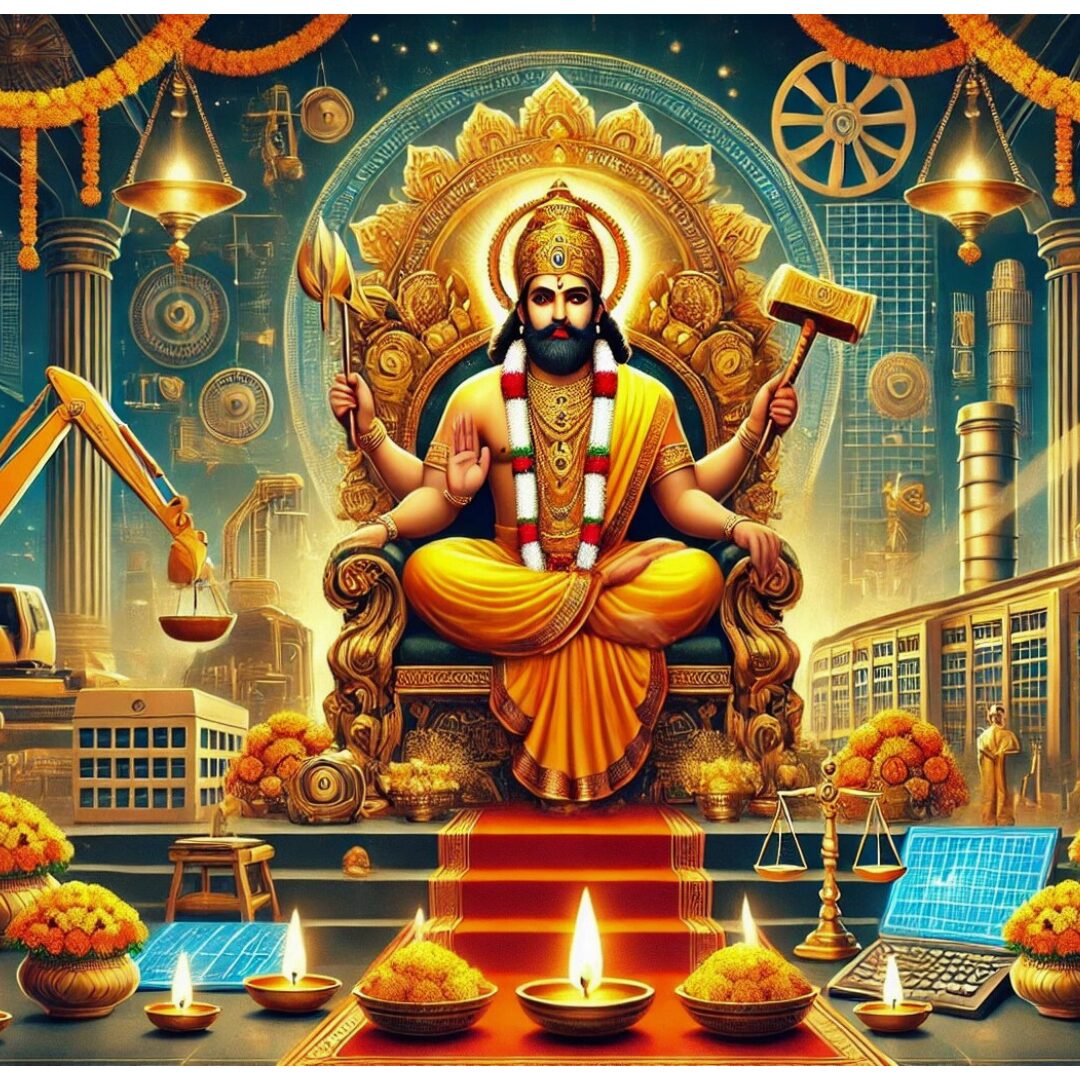
As the golden hues of the setting sun paint the skies on this auspicious day, September 17, 2025, the air across India and beyond buzzes with a unique blend of reverence, creativity, and industriousness. Today marks the grand celebration of Vishwakarma Puja, a festival that pays homage to Lord Vishwakarma, the celestial architect and master artisan of the Hindu pantheon. In factories humming with paused machinery, workshops adorned with marigold garlands, and homes echoing with sacred chants, millions are pausing to honor the god who crafted the very foundations of the universe. If you’ve ever marveled at the intricate carvings of ancient temples or the precision of modern engineering marvels, Vishwakarma Puja is the day to celebrate the divine spark behind it all.
In this blog, we’ll dive deep into the essence of Vishwakarma Puja—exploring its mythological roots, time-honored rituals, profound cultural significance, and the vibrant community it unites. Whether you’re a devout Hindu gearing up for your puja at home or a curious soul intrigued by India’s rich tapestry of festivals, join me on this journey. By the end, you’ll not only understand why Vishwakarma Puja holds such a special place in Hindu hearts but also feel inspired to embrace the artisan within yourself. Let’s get started!
The Mythical Architect: Who is Lord Vishwakarma?
At the heart of Vishwakarma Puja lies the enigmatic figure of Lord Vishwakarma, often depicted as a bearded sage wielding a divine compass, square, and other tools of creation. In Hindu scriptures, he is no ordinary deity but the supreme engineer of the cosmos, the one who sculpted the heavens, forged the earth, and built the grand abodes of the gods. The Rigveda, one of the oldest sacred texts, hails him as the “all-seeing” architect who measures the universe with unerring precision.
Legend has it that Vishwakarma’s lineage traces back to the primordial times. He is considered the son of Prabhata (dawn) and is married to Gupti, symbolizing the union of light and form. His four sons—Manu, Maya, Tvastar, and Shilpi—each inherited facets of his genius: Manu as the architect of humans, Maya for illusions and palaces, Tvastar for divine weapons, and Shilpi for sculptures. These sons embody the multifaceted nature of craftsmanship, from the mundane to the miraculous.
One of the most captivating tales from the Mahabharata involves Vishwakarma constructing the legendary city of Dwarka for Lord Krishna. Submerged today off the Gujarat coast, Dwarka was a floating metropolis of gold and crystal, complete with moats, palaces, and gardens that defied gravity—thanks to Vishwakarma’s ingenuity. Similarly, he built Indraprastha for the Pandavas, a city so splendid it rivaled the heavens. But Vishwakarma’s creations weren’t limited to cities; he crafted Indra’s thunderbolt Vajra from the bones of sage Dadhichi, Shiva’s trident Trishula, and Vishnu’s discus Sudarshana Chakra. These artifacts underscore his role as not just a builder but a protector, infusing the divine with tools of justice and power.
In the Puranas, Vishwakarma is also portrayed as a humble worker, toiling tirelessly in the divine workshop. This humility resonates deeply during Vishwakarma Puja, reminding us that true divinity lies in diligent labor. As we light lamps and offer prayers today in 2025, it’s a poignant reminder amid our fast-paced digital world: creation, whether coding software or carving wood, is a sacred act.indianexpress.com
The Historical Tapestry of Vishwakarma Puja
Vishwakarma Puja isn’t a modern invention; its roots burrow deep into the Vedic era, over 3,000 years ago. The festival aligns with Kanya Sankranti, the sun’s transit into Virgo, symbolizing a shift from chaos to order—a perfect metaphor for Vishwakarma’s craft. Ancient texts like the Vishwakarma Purana and Skanda Purana dedicate chapters to his worship, prescribing rituals that blend Vedic fire sacrifices with folk traditions.
Historically, Vishwakarma Puja evolved as a counterbalance to agrarian festivals like Diwali or Holi, which celebrated farmers and revelers. In a society where guilds of artisans (shrenis) powered the economy—from the Indus Valley’s bronze tools to the Chola dynasty’s bronze idols—Vishwakarma became their patron. Inscriptions from the Gupta period (4th-6th century CE) mention temples and grants to Vishwakarma shrines, highlighting his role in royal patronage.
Colonial records from the British Raj describe Vishwakarma Puja as a “workers’ holiday,” with factories in Kolkata and Mumbai shutting down for tool worship. Post-independence, it gained momentum in industrial belts like Jamshedpur and Kanpur, where labor unions adopted it as a symbol of workers’ dignity. Today, in 2025, with India’s push towards “Make in India” and self-reliance (Atmanirbhar Bharat), Vishwakarma Puja feels more relevant than ever. It’s a festival that bridges ancient lore with contemporary innovation, urging us to honor the hands that build our nation’s future.
The date’s alignment with the equinox also adds a cosmic layer. On September 17, 2025, as daylight balances with night, devotees reflect on equilibrium in creation—much like Vishwakarma’s precise measurements. This year’s celebrations, amplified by social media, are seeing virtual pujas and drone shows depicting his mythical cities, blending tradition with tech.
Rituals and Festivities: How Vishwakarma Puja Unfolds
The magic of Vishwakarma Puja lies in its rituals, which transform everyday workspaces into sacred altars. Preparations begin days in advance: homes and factories are spring-cleaned, symbolizing the purification of the soul and tools alike. On the day itself—today, September 17, 2025—the puja commences at dawn with a ceremonial bath and the invocation of Lord Vishwakarma through the Vishwakarma Mantra: “Om Vishwakarmaaye Namah.”
The centerpiece is the worship of tools. In workshops, hammers, anvils, lathes, and computers are meticulously cleaned and arranged on a raised platform (mandap). An idol or framed image of Vishwakarma—often shown with his consort—takes pride of place, bedecked with sandalwood paste, kumkum, and fresh flowers. Offerings include coconuts, betel leaves, fruits, and sweets like modak or laddoo, representing abundance.
The rituals follow a structured sequence:
- Sankalpa: A vow to perform the puja with pure intent.
- Ganapati Puja: Invoking Ganesha to remove obstacles, as no creation begins without his blessings.
- Main Puja: Chanting stotras (hymns) like the Vishwakarma Stotra while circling the altar clockwise. Incense and lamps are lit, and aarti is performed with bells and conch shells.
- Havan: A small fire ritual where ghee and herbs are offered, invoking Vishwakarma’s fiery forge.
- Prasad Distribution: The sanctified food is shared, fostering community bonds.
Regional flavors add vibrancy. In West Bengal and Odisha, kite-flying soars high, mimicking Vishwakarma’s flying chariots like the Pushpaka Vimana from the Ramayana. Punjab’s Suthars (carpenters) host processions with band music, while Kerala’s Kammalars craft intricate rangolis. In urban centers like Bengaluru, tech parks host “Puja 2.0” with VR recreations of Dwarka.
For families without workshops, a simple home puja suffices: tools from the kitchen or garage stand in. Children often participate by drawing Vishwakarma’s symbols, instilling values of hard work early. As evening falls on this 2025 observance, fireworks light up industrial towns, symbolizing the spark of innovation.
Safety is paramount—workplaces halt to prevent accidents, a nod to Vishwakarma’s protective grace. In a year marked by global supply chain recoveries post-pandemic, this pause feels like a collective breath, recharging for the year ahead.
The Profound Importance of Vishwakarma Puja for Hindus
Why does Vishwakarma Puja resonate so deeply with Hindus? At its core, it’s a celebration of karma yoga—the path of selfless action outlined in the Bhagavad Gita. Lord Vishwakarma exemplifies this: his creations aren’t for ego but for dharma (cosmic order). By worshipping him, devotees affirm that every chisel stroke or code line is an offering to the divine, elevating labor from drudgery to devotion.
In a caste-ridden society, Vishwakarma Puja democratizes spirituality. It honors the unsung heroes—smiths, masons, jewelers—whose skills sustain life. Hinduism’s holistic worldview sees no divide between sacred and secular; temples are built by the same hands that forge plows. This festival counters materialism by infusing work with purpose, combating modern burnout.
Socially, it fosters unity. During Vishwakarma Puja, class barriers dissolve as bosses join workers in prayer. Economically, it’s a boon for small businesses, with markets buzzing for puja items. Environmentally, the emphasis on tool longevity promotes sustainability—repair over replace.
For women in the community, it’s empowering; many lead rituals, challenging gender norms. In 2025, amid rising gig economies, Vishwakarma Puja reminds us of skill’s enduring value over fleeting trends. It’s a festival that whispers: “Create with heart, and the universe aligns.”
Spotlight on the Vishwakarma Community: Guardians of Craft
No discussion of Vishwakarma Puja is complete without the Vishwakarma community, a mosaic of artisans who claim descent from the god himself. Numbering over 20 million in India, they span five primary subgroups, each a pillar of traditional craftsmanship:
| Subgroup | Traditional Skills | Regional Strongholds |
|---|---|---|
| Suthar (Carpenters) | Furniture, temple woodwork, boat-building | Rajasthan, Gujarat, Punjab |
| Lohar (Blacksmiths) | Forging tools, weapons, gates | Uttar Pradesh, Bihar, Odisha |
| Sonar (Goldsmiths) | Jewelry, idols, coin minting | Maharashtra, Tamil Nadu |
| Kammar (Stonemasons) | Sculptures, monuments, well-digging | Madhya Pradesh, Karnataka |
| Tamta (Bronzeworkers) | Bells, utensils, ritual vessels | West Bengal, Jharkhand |
These groups, often under the umbrella of “Vishwabrahmin,” assert Brahmin status through sanskritization—adopting Vedic rites like the sacred thread. Yet, socio-economically, they’re OBCs, facing historical marginalization. From crafting the Taj Mahal’s inlays to modern auto parts, their legacy is India’s backbone.
Vishwakarma Puja is their cultural anchor. Community halls host feasts, and youth forums discuss upskilling in AI-aided design. Challenges persist—urban migration erodes trades, and mechanization threatens jobs—but resilience shines. Initiatives like the Vishwakarma Yojana (launched in 2023) provide skill training, revitalizing the fold.
In 2025, diaspora communities in the US and UK adapt with online pujas, preserving heritage amid globalization. Figures like architect Charles Correa or sculptor Anish Kapoor trace indirect inspiration to this ethos, proving the community’s global ripple.
Vishwakarma Puja in the Modern World: 2025 and Beyond
Fast-forward to today: Vishwakarma Puja 2025 isn’t just rituals; it’s a lens on progress. In India’s burgeoning space program, ISRO engineers invoked Vishwakarma before Chandrayaan-3’s success. Factories in Noida use AR for virtual tool blessings, merging myth with metaverse.
Globally, sustainability echoes his precision—think 3D-printed eco-homes. Yet, challenges loom: automation displaces artisans, urging reskilling. Vishwakarma Puja calls for ethical tech, ensuring creation serves humanity.
As night envelops us on September 17, 2025, gaze at the stars Vishwakarma mapped. In a divided world, this festival unites through craft’s universal language.
In Conclusion: Ignite Your Inner Creator
Vishwakarma Puja is more than a day off—it’s a manifesto for mindful making. From Vedic verses to viral videos, it evolves, yet its soul remains: honor the creator in all. This 2025, as tools gleam anew, may Vishwakarma’s blessings forge paths of prosperity and peace.
What does creation mean to you? Share in the comments—perhaps your story of a cherished craft. Until next puja, keep building, keep believing.