

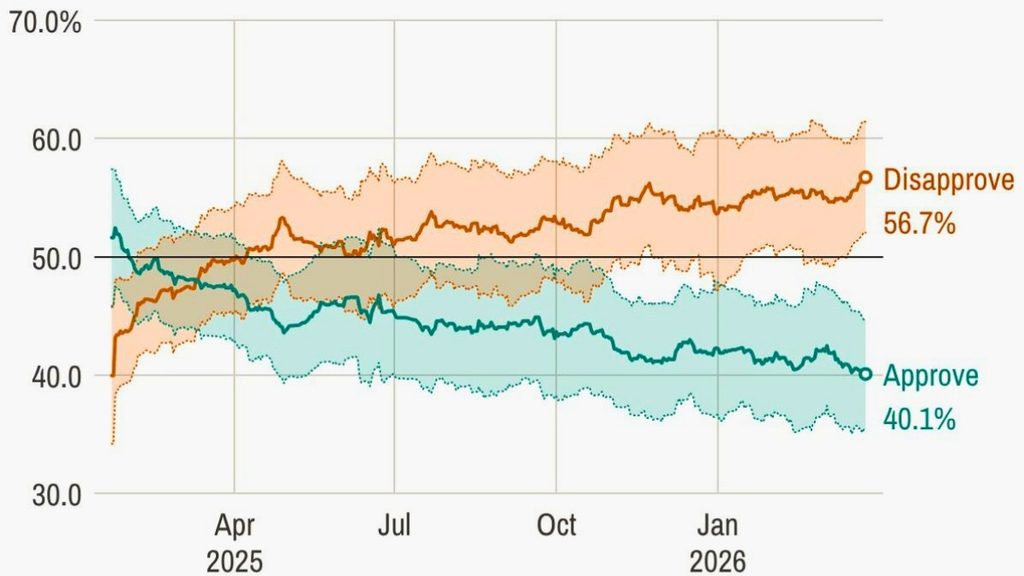
President Donald Trump’s approval rating has fallen to historically low levels during his second term, according to several major polling organizations.
The latest Reuters/Ipsos poll puts Trump’s approval rating at 33%, while 64% of Americans disapprove of his performance as president. The August poll marked the third consecutive Reuters/Ipsos survey in which Trump’s approval stood at 33%.
Pew Research Center also found Trump’s approval at 34% in its August analysis, describing the rating as low by historical standards for a president at a comparable point in office.
The numbers highlight a difficult political environment for Trump as his administration moves toward the 2026 midterm elections.
What Is Donald Trump’s Approval Rating Right Now?
According to the latest Reuters/Ipsos poll conducted in late August 2026:
- Approve: 33%
- Disapprove: 64%
- Net approval: -31 percentage points
The survey included 1,167 U.S. adults and had a margin of error of approximately 3 percentage points. Trump’s 33% approval rating is his lowest level in the Reuters/Ipsos series and has remained there for three consecutive polls.
Pew Research Center’s separate polling also found Trump at 34%, providing another indication that his overall approval rating is currently in the mid-30s.
It is important to remember that individual polls can produce different results. Polling averages combine multiple surveys and can therefore give a somewhat different picture.
For example, the RealClearPolling average covering July 22 through August 30 showed Trump at approximately 39.7% approval and 56.8% disapproval.
Why Has Trump’s Approval Rating Fallen?
Several issues appear to be contributing to Trump’s weaker approval numbers.
The economy and cost of living have become particularly important concerns for voters. In the latest Reuters/Ipsos survey, 71% of Americans disapproved of Trump’s handling of the cost of living, including significant dissatisfaction among Republicans.
Higher prices, gasoline costs and concerns about household finances can have a direct effect on presidential approval because voters often judge economic conditions through their everyday expenses.
Trump’s handling of foreign policy and the war involving Iranis another major factor.
Only 36% of Americans in the Reuters/Ipsos poll supported the war, while opposition was considerably higher. The conflict has also contributed to concerns about gasoline prices and inflation.
These issues create a difficult political combination for the administration: voters are concerned about both economic affordability and the consequences of military involvement overseas.
Trump’s Approval Among Republicans
Trump continues to receive substantially stronger support from Republicans than from Democrats or independents.
This partisan divide is one of the defining characteristics of Trump’s approval ratings.
Pew Research Center found a 78-percentage-point partisan gap in Trump’s job approval in its August analysis. His support among Republicans remained dramatically higher than among Democrats.
That means Trump’s national approval rating does not tell the entire story.
A president can have relatively low overall approval while retaining strong support within his own party.
For Trump, maintaining Republican support will be particularly important as the 2026 midterm elections approach.
Independent Voters Could Be Crucial
Independent voters are another important group to watch.
Presidential approval ratings can move significantly when independents become more negative or positive toward an administration.
The latest Reuters/Ipsos polling suggests that Democrats currently have an enthusiasm advantage heading into the midterm elections. Among respondents identifying as independent, the poll also showed Democrats holding an advantage over Republicans on the congressional preference question.
That does not mean the election outcome is predetermined.
Midterm elections depend on turnout, individual congressional districts, candidate quality and the political environment closer to Election Day.
However, weak presidential approval can create additional challenges for the president’s party.
Trump’s Economy Approval Is Under Pressure
The economy has traditionally been one of the most important factors influencing presidential approval.
Trump campaigned heavily on economic issues, including prices, energy and growth.
But voters’ assessments of economic conditions have become more negative.
The latest Reuters/Ipsos poll found particularly weak ratings for Trump’s handling of the cost of living. That issue could remain important if inflation and energy prices continue to affect household budgets.
Interest rates are another factor.
The Federal Reserve’s monetary policy affects borrowing costs, mortgages, businesses and consumer spending. Trump has repeatedly pushed for lower interest rates, while the Federal Reserve has emphasized the need to bring inflation closer to its 2% target.
That creates another potential political tension between the White House and the central bank.
Trump’s Approval on Foreign Policy
Foreign policy has also become a major part of the approval-rating story during Trump’s second term.
The Iran conflict has become particularly significant because it combines military, geopolitical and economic concerns.
According to the latest Reuters/Ipsos survey, only 36% of Americans supported the war, while Trump’s handling of the conflict has faced significant public criticism.
Foreign-policy approval can change quickly when events on the ground change.
A successful diplomatic agreement or reduction in military tensions could improve public sentiment.
A prolonged conflict, rising casualties or higher energy prices could have the opposite effect.
How Does Trump’s Current Rating Compare With His Earlier Presidency?
Trump’s approval rating has historically been highly polarized.
During his first presidency, he rarely achieved majority approval in national polling.
His second-term approval also began from a stronger position than where it stands now, but support has weakened as voters have responded to economic and foreign-policy developments.
Pew’s August 2026 analysis concluded that Trump’s current approval rating is low compared with recent presidents at similar points in their presidencies.
The important point is that approval ratings can change.
A low rating in September 2026 does not necessarily predict Trump’s approval at the end of his presidency.
Economic conditions, inflation, international conflicts and major domestic policy decisions can all change public opinion.
What Does Trump’s Approval Rating Mean for the 2026 Midterms?
The 2026 midterm elections will be one of the biggest political tests of Trump’s second term.
All seats in the U.S. House of Representatives and a portion of the Senate will be contested.
Historically, the president’s popularity can influence the performance of the president’s party in midterm elections, although many other factors also matter.
The latest Reuters/Ipsos poll found that Democrats were more enthusiastic about voting than Republicans, with 46% of Democratic respondents describing themselves as very enthusiastic compared with 31% of Republicans.
That gap could matter if it persists into the election campaign.
However, it is too early to translate a national approval number directly into a prediction about congressional control.
The electoral map, local candidates, turnout and individual races will all play important roles.
Why Different Polls Show Different Trump Approval Ratings
Readers may notice that one poll reports Trump at 33%, another at 34%, and a polling average closer to 40%.
That does not necessarily mean that one poll is wrong.
Different surveys use different methodologies, sample populations, field dates and weighting systems.
A poll of registered voters can produce a different result from a poll of all adults. Polls can also differ depending on whether they survey likely voters.
Polling averages attempt to combine multiple surveys and can therefore provide a broader picture.
For that reason, it is better to look at both individual high-quality polls and polling averages rather than relying on a single number.
What Could Improve Trump’s Approval Rating?
Trump’s approval rating could improve if voters become more optimistic about the economy and household finances.
Several developments could potentially help:
- Lower inflation
- Falling gasoline prices
- Stronger economic growth
- Lower borrowing costs
- Progress toward ending the Iran conflict
- Improvements in consumer confidence
- Successful implementation of popular policies
Presidential approval is not fixed.
If economic conditions improve substantially, voters who currently disapprove of the administration could become less negative.
What Could Push His Approval Even Lower?
The opposite developments could create additional pressure.
These could include:
- Persistently high inflation
- Rising gasoline prices
- A prolonged war involving Iran
- Weak economic growth
- Higher unemployment
- Continued dissatisfaction among independent voters
- Political divisions within the Republican Party
The economy may be particularly important because voters often experience economic conditions directly through food, housing, fuel and other household expenses.
Frequently Asked Questions
What is Donald Trump’s approval rating in September 2026?
The latest Reuters/Ipsos poll puts Trump’s approval rating at 33%, with 64% disapproving. Pew Research Center’s August analysis placed his approval at 34%.
Is Trump’s approval rating at a record low?
The latest Reuters/Ipsos polling places Trump at 33%, his lowest level in that polling series and a career-low figure reported by Reuters.
Why is Trump’s approval rating so low?
Recent polling points to concerns about the cost of living, economic policy and the Iran conflict as important factors behind Trump’s weaker approval numbers.
Does Trump’s approval rating predict the 2026 midterm elections?
Not by itself. Approval ratings can provide an indication of the political environment, but congressional races are also influenced by turnout, candidates, district-level conditions and campaign issues.
Do all polls show Trump below 35%?
No. Different polls and polling averages produce different results. For example, the latest Reuters/Ipsos poll showed 33%, Pew reported 34%, while the RealClearPolling average covering late July through August 30 was approximately 39.7%.
Final Takeaway
Donald Trump’s approval rating has fallen to historically weak levels during his second term.
The latest Reuters/Ipsos survey shows 33% approval and 64% disapproval, while Pew Research Center’s separate analysis places his approval at 34%.
The biggest challenges for Trump appear to involve the cost of living, economic policy and the Iran conflict.
At the same time, Trump’s support among Republicans remains considerably stronger than his support among Democrats, highlighting the highly polarized nature of American politics.
With the 2026 midterm elections approaching, Trump’s approval rating will remain an important indicator of the political environment.
But the number should be viewed as a snapshot rather than a prediction. Economic conditions, inflation, foreign-policy developments and voter sentiment can change significantly over the coming months.
For that reason, this page will be updated as new major national polls become available.
This article is for informational purposes only and is not intended to provide political, financial or investment advice.
After looking over a number of the blog articles on your site, I
really like your technique of writing a blog. I book marked it to my bookmark webpage
list and will be checking back soon. Please check out my web
site as well and tell me how you feel.